Transportation in Switzerland
Pick a category below or scroll down to read everything:
Your trip to Switzerland
Travelling in Switzerland
Public transport
Travelling by train
Season tickets for public transportation
Traffic regulations
Driving in the mountains
|
|
The airport of Zürich.
|
|
Picture: W. Loosli, Unique. |
If you come a long way you might want to fly to Switzerland. The main international airport is Zürich. There is a train station so that you can easily reach your final destination. Zürich airport offers through trains to many Swiss town and some towns abroad. Other destinations require changing trains, often at nearby Zürich HB (Haubtbahnhof, central station). It can be convenient to spend the night after arrival or prior to departure close to the airport. There are comfortable hotels available near the airports of Zürich, Geneva and Basel. The hotels can be reached quickly, and in many cases, for free.
You can consider a train journey if you travel within Europe. France, Italy, Austria, Germany, The Netherlands and Belgium offer through trains to Switzerland. Many trains have a restaurant on board and there are night trains on some routes so that you can sleep at night and arrive early in the morning. It is recommended to book seats in advance. If you are reluctant to carrying your luggage on and off trains, there is often a possibility to have your suitcases sent to your holiday address or the railway station at your destination. Please ask your railway company for details.
You can also travel by car. The Bernese Oberland can be reached easily by excellent expressways from the north, and from the south by using the car train across the Lötschberg tunnel between Goppenstein and Kandersteg. Wallis can be reached most easily via Montreux and Martigny, and from the north by using the aforementioned car train service. Graubünden can best be approached from the north (Chur, Thusis) or the south west (Bellinzona). You should take into account that many other destinations in Graubünden require using smaller roads during the last part of your journey. That applies to some destinations in the Bernese Oberland and eastern Wallis as well.
|
|
The Sustenpass.
|
Although Switzerland is a small country, travelling times are often longer than expected. Taking the shortest way is not always an option in mountainous regions. Particularly in the south, where the highest mountains are situated, you will often be dependant on tunnels and passes. In winter time, drivers should take into account that some passes are closed. Car trains can sometimes be used instead. In other cases, you will have to make a detour through a road which is still passable. Some car train services are available outside the winter season as well. A car train makes your trip more expensive but can be a time saver and will spare you from crossing a difficult pass. This form of transport is offered more and more, especially for freight traffic. The Swiss tend to choose for rail transportation instead of road transportation more often when building or improving major transit routes. Crossing a pass is a great experience. Often there is a magnificent view and the landscape above the timberline is rough and impressive. It is advisable to get some information about the quality of the road in advance. Many passes can easily be crossed in summer. Others are a bit more difficult due to small roads, narrow curves and steep slopes. For this reason, some passes are not accessible for home trailers. Switzerland has excellent expressways, but there are quite some areas without any expressways at all. This goes for many parts of Graubünden (among others). Gas stations offer diesel and unleaded fuel ("Bleifrei 95" and "Bleifrei 98"). LPG is only available from 57 gas stations (as of February 2005). In general, fuel is cheaper at gas stations that are not located along an expressway. Fuel is about CHF 0.40/liter cheaper in the tax-free enclave of Samnaun in Graubünden.
|
|
A postcar.
|
|
Picture: PicSwiss. |
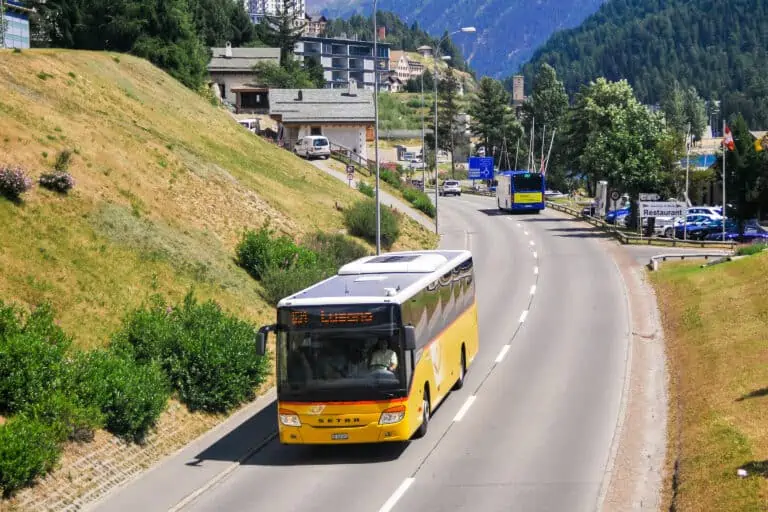
Swiss public transport is of high quality. This applies to both the public service vehicles and the punctuality of the time table. Lots of places can be reached through a network of trains, busses, ships and gondolas. This network is also referred to as the 'Swiss Travel System', which can be used if you posses a Swiss rail pass. Major cities are connected by InterCity trains which usually run once per hour. Busy connections often provide at least two trains per hour. Busses play an important role as well. Bus services are often provided by the Swiss post services 'Die Post'. The name 'postcar' originates from a long time ago. Nowadays, these busses are mainly carrying passengers, although small villages still have their post delivered by postcars. Generally spoken, transportation to small villages starts early in the morning and ends early in the evening. These busses or trains usually run once an hour, but this can be less as well. It is recommended to take that into account when planning your trips. The Swiss timetable helps you planning.
|
|
The major railways.
|
Public transportation is a safe and comfortable way to explore Switzerland. However, you will have to plan your trips a bit because the timetable can be rather limited sometimes. Not all, but many places can be reached using public transport.
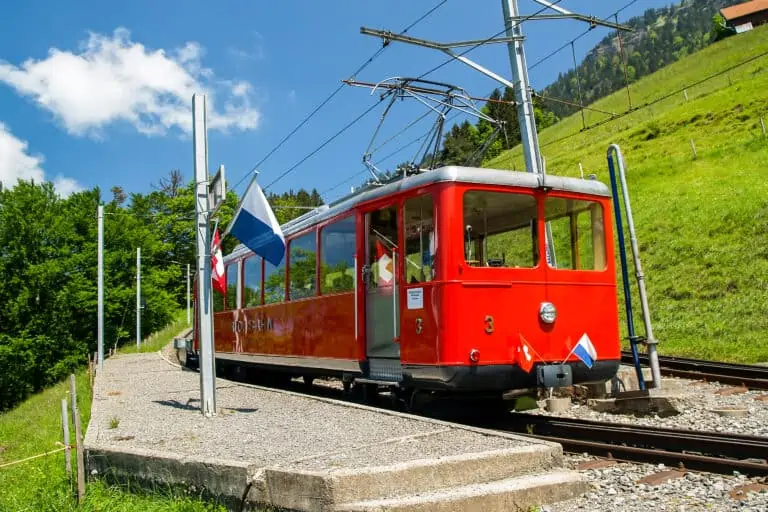
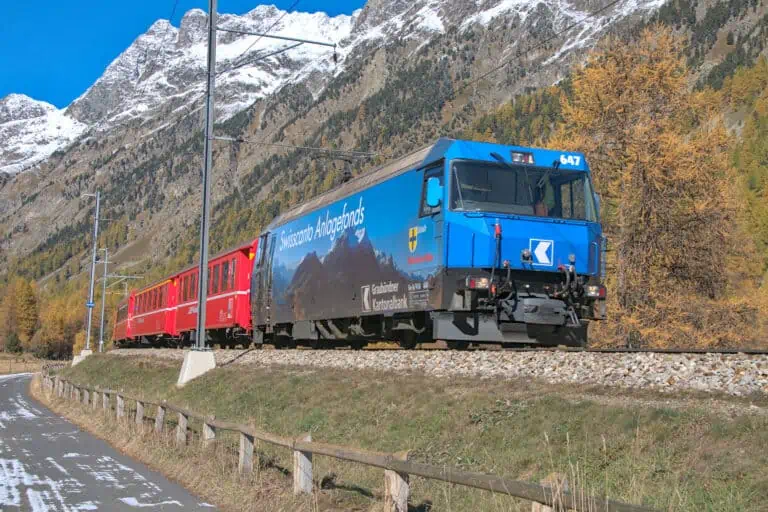
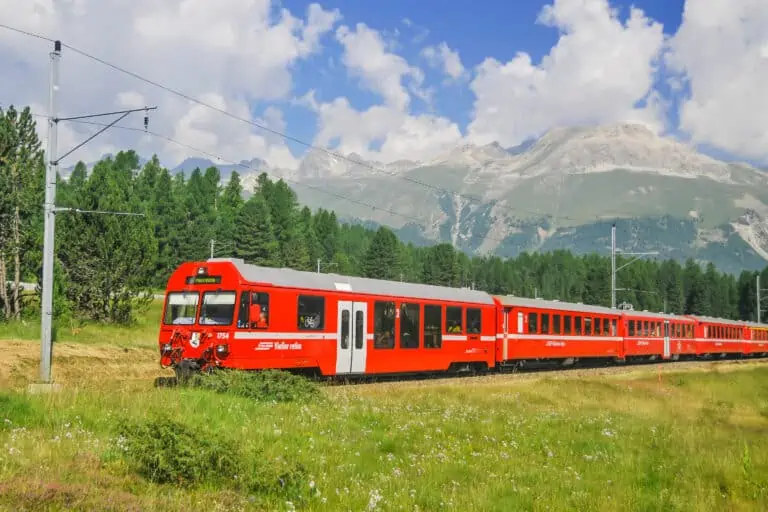
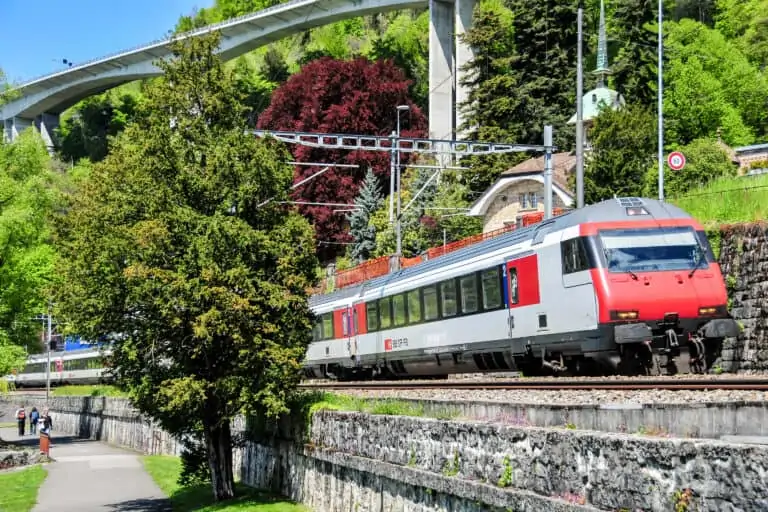
Train enthusiasts will definitely love Switzerland. In addition to the national railway company, there is a great number of regional companies (refer to Links). The average passenger usually doesn't notice this, since tickets are mostly valid for all companies. But if you pay special attention to this you will find a great variety of locomotives and other rolling stock. Most of the rolling stock is driven by an electric motor.
|
|
The new Gotthard tunnel under construction.
|
|
Picture:
AlpTransit. |
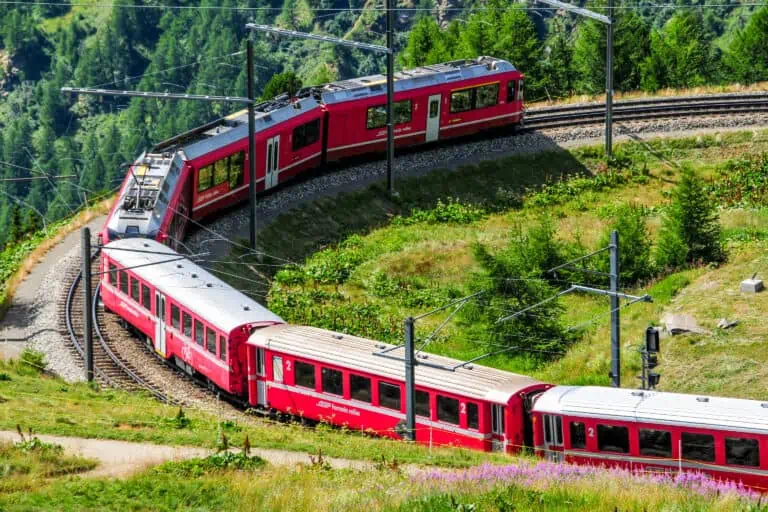
Some tourist railroads use steam locomotives. A lot of special railway techniques can be found: in addition to standard gauge, narrow gauge is frequently used because it allows narrow curves which often are necessary in mountainous areas. There are a lot of cog railways, allowing trains to cross terrain which would otherwise be inaccessible. Spiral loops are an alternative for cog railways: by making the route between two points longer, the gradient is less severe than if a direct track is used. A combination of both techniques is sometimes necessary to gain enough height. The Rhätische Bahn (Rhaetical Railways) in Graubünden is an example of a railway company that did not choose for cog railways and therefore many spiral loops can be found in that region. Long railway tunnels are a masterly example of railway engineering as well, although they are not that exciting for passengers. Tunnels make cog railways and spiral loops unnecessary and the travelling time decreases excessively. A new Lötschberg tunnel between Frutigen (Bernese Oberland) and Raron (Wallis) has been opened in 2007. This 34 km (21 miles) long tunnel shortened travelling time between Northern and Southern Europe by 30 minutes. Regional trains will continue to use the old Lötschberg tunnel between Kandersteg (Bernese Oberland) and Goppenstein (Wallis). Work is also being done on a new 57 km (35 miles) long Gotthard tunnel, which should relieve the old 19 km (12 miles) long tunnel in 2015. Both tunnels are mainly meant for international passenger trains and freight trains, resulting in less freight traffic on the road. Mountainous areas are also home to lots of impressive bridges. Some examples are the stone built Landwasser viaduct near Filisur in Graubünden and the steel Bietschtal viaduct near Raron in Wallis.
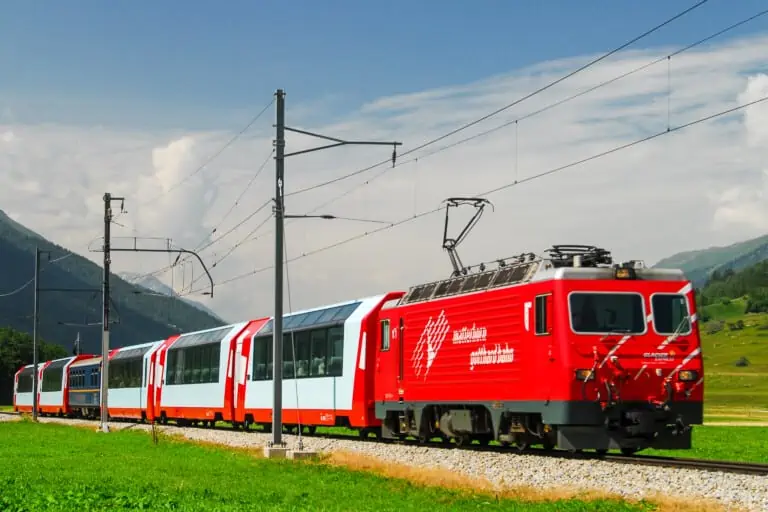
As mentioned before, rolling stock can be found in lots of variants. That does not only apply to the locomotives belonging to the many different railway companies; sometimes they are printed with advertisement, resulting in an even more varied picture. There are many different train sets and coaches as well. Some companies own panoramic coaches, with wide high windows and often a ceiling which is largely made of glass as well. You don't have to miss out on anything when travelling in one of these coaches.
 |
|
The fast Cisalpino is crossing the Bietschtal viaduct.
|
|
Picture:
IGE-Bahntouristik. |
The Swiss and the Italian joined forces in order to develop the Cisalpino train set, which is designed for speeds up to 200 km/h (124 mph). Its tilting system allows the train to cross curves at a higher speed than before. Switzerland does not have its own high speed railway lines, but it is assured from fast connections with its neighboring countries; a number of foreign high speed trains, like the French TGV and the German ICE, visit Switzerland on a daily basis. The Swiss use double deck coaches on busy routes. Some experiments have been made with McDonald's restaurants and supermarkets on board of InterCity trains. A restaurant is more or less a standard facility on the main InterCity connections and international trains.
| Economical travelling across Switzerland is possible using a Swiss rail pass. |
|
Since the Swiss feel that environmental protection is very important, cargo transportation by train occupies an important place in order to limit the amount of road traffic. Long freight trains can be spotted on the Lötschberg route (Bern - Spiez - Brig) and the Gotthard route (Altdorf - Bellinzona - Chiasso). Trains are playing a relatively important role in Swiss society. A railway company not only provides transportation, but often offers tourist services as well, like (educational) hikes and other day trips. Some Swiss villages can only be reached by train during winter or even during the whole year. The smallest railway stations are generally in use as a 'Halt auf Verlangen' (request stop). This means that the train will only stop in case a passenger on the platform or in the train has pushed a button. The timetable shows to which stations this applies.
If you would like to capture some of these activities on video or photo, a little preparation is necessary. Taking pictures along the track can be difficult in mountainous areas because many locations can simply not be reached. Trees and tunnels are often blocking the view on the train. Nonetheless, there are many locations which are suitable for this hobby. For example, the aforementioned Landwasser viaduct and the Bietschtal viaduct can easily be photographed during a hike (unfortunately the number of trains on the latter has decreased due to the availability of a quicker route through the new Lötschberg tunnel). The many possibilities for beautiful train trips and photography draw many train enthusiasts to Switzerland each year.
It is advisable to inquire about the several tickets for public transport in advance. Buying separate tickets for each trip is rather costly. A season ticket can save you a lot of money, and it will also spare you from going to the ticket office for each trip. Which ticket is most suitable for you depends on the distances you plan to travel, the number of trips and the region you would like to explore. Please take into account that you are sometimes obliged to pay a surcharge or book seats for services such as high speed trains, even if you have a ticket for 'unlimited travelling' such as a Swiss Pass.
If you want to travel across multiple countries, there are European rail passes such as Interrail (for European citizens) and Eurail (for non-European citizens).
If you choose for a season ticket which is valid in the entire country, and if you are also travelling to Switzerland by train, it can be attractive to order a return ticket to the Swiss border, instead of a ticket to your final destination. The trip from the border to your destination can be made by using your season ticket. For example: if you travel from Germany you can order a return ticket to Basel Bad Bf, the border station in Basel, Switzerland. You can start using your season ticket here.
 |
|
The Autobahnvignette is required to use the expressways in Switzerland.
|
A list of some important Swiss traffic regulations can be found below:
- Car and motor drivers are obliged to pay motorway tax by purchasing an Autobahnvignette (a sticker for your car) if they plan to use expressways, which is inevitable if you want to keep travelling times limited. A trailer requires a second sticker. An Autobahnvignette is valid for 14 months (from December of the foregoing year until January of the next year). The vignette can be purchased online, or at the Swiss border, gas stations and TCS-offices (refer to Links). Outside of Switzerland, the sticker can usually be purchased at your local automobile association, border exchange office or travel agency. It is convenient to buy the Autobahnvignette in advance and stick it on the inside of your windshield. That allows you to pass the border more quickly using the lane for vehicles which already have a vignette. A car that is rented in Switzerland already has an Autobahnvignette. Toll must be paid for some tunnels and private roads, regardless of the possession of an Autobahnvignette.
- In order to rent a car, a valid driver's license held for at least one year is required. The minimum rental age is 20 to 25 years, depending on the rental company.
- It is obligatory to switch the dimmer lights on, also during the day and in well-lit tunnels.
- All traffic coming from the right has priority, so cyclists as well.
- Police cars, ambulances, fire engines, trams and buses always have priority.
- All passengers have to wear a seat belt.
- Children up to 7 years of age need to sit in a child's seat. Never use a rearfacing child's seat in the right front if the vehicle is equipped with a passenger side air bag.
- Motorcyclists and their passengers are compelled to wear helmets.
- The driver of a motor vehicle must be at least 18 years old. Drivers must be able to show their driver's license, car registration papers and insurance details.
- You are not allowed to drive from a blood alcohol level of 0.5 g/l.
- Radar detection systems are not allowed.
- A warning triangle must be at hand (so it may not be carried in the trunk).
- Drivers wearing spectacles or lenses, must have an extra pair of spectacles in their car.
- A first aid kit and a fire extinguisher are not compelled, but of course it is advisable to have them.
- The vehicle must have a country indication on it.
- Only hands-free calling is allowed, but it is adviced against.
- Navigation equipment warning for speed measurement devices, traffic light cameras, etc., is prohibited. POI (Points Of Interest) of such locations may not be installed on your device.
- Snow chains are not necessary in summer. It is useful to have them at hand in winter, but it is not compelled. However, you are not allowed to obstruct traffic because you failed to prepare your vehicle for the local weather conditions. Signs indicate when snow chains are compelled for a specific road. In that case, the chains must be attached to at least two driven wheels.
- Spiked tires are only permitted on Swiss cars and from late October to April. The speed limit with spiked tires is 80 km/h (50 mph) and that must be indicated on the car. Spiked tires are not allowed on most expressways and highways during the whole year.
| |
Car or motor
|
Car with trailer
|
| In built-up areas | 50 km/h, 31 mph | 50 km/h, 31 mph | | Outside built-up areas | 80 km/h, 50 mph | 80 km/h, 50 mph | | Highways | 100 km/h, 62 mph | 80 km/h, 50 mph | | Expressways | 120 km/h, 75 mph | 80 km/h, 50 mph Motor homes > 3.500 kg: 100 km/h, 62 mph |
An overview of the speed limits.
Traffic fines are generally heavy. Foreigners may be expected to pay (part of) the fine on the spot.
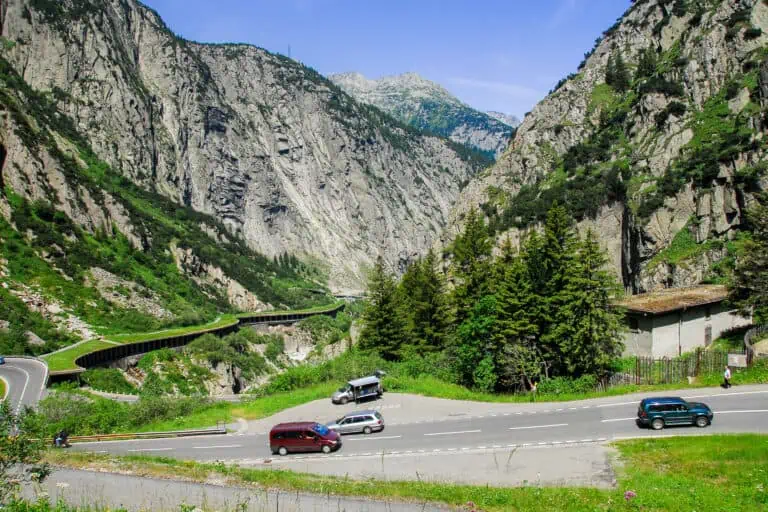
Driving in the mountains requires an adjusted driving style. Mountain roads are sometimes narrow, have a lot of sharp curves and may pass along deep ravines. A crash barrier or fence, if present, is not always designed to actually stop a vehicle. You have to share the road with cyclists, sometimes with pedestrians and even with cows that graze on the meadows in summer. So, concentrated driving matters greatly.
|
|
A hairpin bend between Schattenhalb and Rosenlaui near Meiringen.
|
It is important to utilize the hauling capacity of the engine as best as possible when ascending. This means that you do not change gears as quickly as on flat roads, in order to keep a high engine speed (3000 - 4000 revolutions/min). The speed of the vehicle should be relatively low for safety reasons. Assuming a 5-gear car, it is usually sufficient to use gear 1 to 3 only. You also use a low gear and a high engine speed when descending. You can often use the same gear that proved to be useful during the ascent. The deceleration will be done by the engine this way. It saves the brakes, that can get too warm if you use them continuously. When you continue to gain speed, pick a lower gear or occasionally gently use the breaks. The accelerator pedal will not be necessary during most of the descent. It is bad for a car to pull in the clutch in order to gain speed. Do certainly not drive down with the transmission in neutral. In most cars with automatic transmission, you can just use the regular D-position. On slight grades, it may be necessary to pick a low gear to prevent the car from changing gears too frequently. In such cases, use position 1 or 2 or the mountain gear if available.
Your view can be blocked heavily in curves with rock walls or trees along the road, so you need to adjust your speed there. Sometimes there is a mirror to improve the view. You can sound the horn to warn oncoming traffic, but only do that when it is really necessary and do not do it in built-up areas. You need to decelerate before the curve, not when you are already in the curve. Once in the curve, you may step on the gas to improve traction. Beware to you keep on your own (right) lane, especially in outside curves. Many people tend to steer towards the inside of the curve.
The engine can run hot if you are ascending while using a gear that is too high. Every car has a thermometer to monitor the engine's temperature. Change to a lower gear and therefore a higher engine speed if the temperature keeps rising. Turning off the airconditioning to save power might help as well. You may even turn on the heating to withdraw energy from the engine. If all attempts fail you need to pull over before the temperature gets too high, so that the engine can cool down. The brakes can run hot if you are using them too much, e.g. because the engine does not decelerate. Not all cars have a signal for this problem, but you can manually feel if the wheels are warm. Hot brakes get worse rapidly and may fail completely! An unpleasant smell might be an indication for hot brakes. In that case you need to pull over immediately to check it. Quick action is necessary if you notice that your brakes fail while you are driving. Try to decelerate by pulling and releasing the brakes repeatedly, or try one more pull with hard pedal pressure. Only use the handbrake if the road is not slippery, otherwise you will lose control of the vehicle completely. If necessary, change to gear 1 or 2 without shifting to neutral, hopefully causing the engine to decelerate. You can also turn into an ascending side-road or meadow to decelerate, or scrape the car at a small angle to a (rock) wall along the road.
Ascending traffic has priority over descending traffic, because descending vehicles can start more easily after coming to a full stop. So, on narrow roads, descending traffic has to clear space for ascending traffic. A postcar always has priority, even if it is descending while you are ascending. When curves are ahead, the bus usually announces its presence with its characteristic horn. Stop well before the curve because a bus in a narrow curve needs all the space that is available. Keep plenty of clear space when overtaking ascending cyclists, and use your direction indicator. Overtaking descending cyclists is usually not necessary since they are at least as fast as cars. Keep at a safe distance though. Drivers of slow vehicles may help you with a short signal with their right indicator to show you that you can overtake safely. You can do that yourself as well if faster drivers are following you. Beware of obstructions such as cows or rubble. You can warn following traffic by switching on the emergency signals. Do not pull over on places with rubble on the road, because the risk of more rubble coming down is greater there. Mountain roads sometimes have unlighted tunnels. Check if the lights are switched on (this is compelled anyway, also during the day), take off your sunglasses and adjust your speed. Tunnels are often cold and moist so water may drop down.
You can do a number of things to prevent that your car starts moving out of its own when parked on a slope. You definitely need to use the handbrake and shift the transmission to first gear. When the slope is very steep you may put a stone behind the wheels and turn the steering wheel so that the car can not roll very far.
|