Hi,
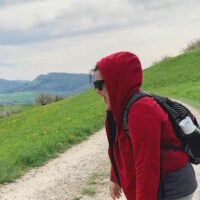
We just returned from our trip from the Bernese Oberland and I have yet to find time to do a trip report as there are so many details to share, I frankly am at a loss to start. Nevertheless, I will try to address your question first. My husband and I are almost 70 and we come from a tiny city state Singapore where we are not used to hiking, let alone tackle any walking trails like those in Switzerland. I am not sure where you are from and whether your relative is used to hiking or taking long walks up and downhill, so I will share from our own personal experience:
We didnt have any hiking boots when we arrived but realised that we needed a good pair because of the trails we saw. Most of it is on uneven surfaces, with lots of gravel, some challenging slopes up and down (even those trails marked yellow) – when I say challenging I am referring to seniors like us in our very late 60’s… In the end, we decided to invest in a pair of LOWA made in Germany hiking boots each and that was a really good choice. It helped to keep our ankles firm and more stability on uneven ground during the “walks”. Thankfully we brought our hiking poles which are a tremendous help as it helped to support us quite a bit esp going uphill.
1) Eigergletscher to K.Scheidegg – contrary to what I read about this being an “easy” walk. It is a downhill walk with long descends in this direction. No sudden steep sharp slopes but full of large gravel and stones and due to the long continuous descend – it is very easy to start slipping on the way down and can be a strain on the knees and the shin. The description is from our godson who is in his early forties who did the walk. My husband and I decided not to do this as we could see that it’s not as easy as we first thought or read. Advice: Poles and sturdy boots are strongly encouraged to keep senior steady if she intends to do this walk.
2) K.Scheidegg to Wengernalp -We did this walk and it was one of our favourites. This is a beautiful easy walk and we saw lots of yellow and white wildflowers when we were there on the 19/6/23. The views are also amazing. Definitely manageable as it’s a gentle downhill on quite a decent path (make sure you stay on the cyclist path and not deviate).. We were told to only stop at Wengernalp and take the train back to Wengen where we were based. Do NOT carry on to Wengen by foot as we were told by several who did so that it is pretty challenging and steep in some placesif you carry on to Wengen. Advice: Hiking boots or poles are not necessary.
6) Mannlichen Royal Walk – it’s a huff and a puff up and you do get great views.. Poles will be a big help for the senior when going up. Hiking boots are not necessary but good sturdy shoes to handle gravel.
I noticed you did not include THE PANORAMIC WALK from Mannlichen to K. Scheidegg – it’s a wonderful definitely doable walk for all young and old. For the senior, a pole and good sturdy sport shoes is good enough esp if she is reasonably fit. If you only had time for one walk up in the alps, this is one walk I would definitely recommend. You see the alps in front of you all the time (don’t do it the other way round). There are benches along the way for a short break. Bring some chocs or snacks or you can drop in at the Grindewaldblic restaurant which is located just before you reach K. Scheidegg. The Beef goulash is good!
Do take note that when we were in Murren last week, there was lots of construction going on at the section at the last part of Murren leading to the Schilthorn station. So lots of trucks and vehicles making the walk rather unpleasant. They are building a new cable car station or something – I pity those who chose to stay at accomodations at that end. If you do make it there, remember to do the BIRG THRILL WALK which allows you a panoramic view as you walk from one end to the other (Birg is one station below Schilthorn) – google this on Youtube to have an idea. It’s way more thrilling than the First Cliff Bridge.
We didnt do the other walks you mentioned so I can’t comment.
Basically, alot of the trails do require sturdy walking or hiking boots inorder to protect one’s ankles because of uneven terrain. Alternatively, she can take a risk with just a very good pair of track or sports shoes and not do some of the more challenging trails. She could also invest in hiking boots if she still wants to do those slightly more challenging trails – there are lots of sports shops in the little towns. I needed to get used to the hiking boots as I was not used to them but after using them, I realised how important they are when handling the ups and downs of certain slopes and steps and stones.
From experience, practically all trails have uneven terrain so it’s a matter of how fit she is and how steady her legs are. We found that using at least one hiking pole helped as did the hiking boots.




 AI-generated summary