
 MySwissAlps.com includes
 This page was last updated by
 The weather in Switzerland: anything is possible
The Swiss Alps: a border between weather types
Nowhere is the weather more changeable than in the mountains. The Swiss Alps are the border between the cooler northern European climate and the warmer southern European climate.
Mountains often form the separation between different kinds of weather. So varying types of weather can be found in Switzerland at the same time.
Variations at a regional level
Variations can even occur at a regional level. While the sun is shining in one Swiss valley, it may be raining on the other side of the mountain in the adjacent valley.
Quick changes during the day
The weather may clear up very fast, even within minutes. So a cloudy, drizzly morning does not necessarily have to be a sign for a full day of bad weather.
It goes the other way around as well: on a beautiful day it may suddenly become cloudy and rainy. This is something to take into account for outdoor activities.
Temperatures
How warm it gets in Switzerland
In summer, you can expect day temperatures ranging from 20 °C (68 F) to 35 °C (95 F) in the lower valleys. These are averages. It can get 40 °C (104 F) or warmer during heat waves. And it might as well be 15 °C (59 F) on a rainy day, while it freezes on a high mountain top.
How cold it gets in Switzerland
In winter, day temperatures can range from freezing point to 10 °C (50 F) in the lower areas and most larger towns. In high-alpine regions such as the Engadine, temperatures are usually around or below freezing point all day long. At the highest mountain tops, expect temperatures of -10 °C to -15 °C (14 F to 5 F).
Switzerland’s warmest months and regions
- Warmest months: July and August
- Warmest areas: Lake Geneva, the western Rhône Valley between Villeneuve and Brig, and the valleys in the south of the Ticino. All low-elevation areas around lakes and rivers from the West to the North-East (Geneva – Zurich – St. Gallen) are pretty warm as well.
Switzerland’s coolest months and regions
- Coolest months: January and February
- Coolest areas: all places high up in the mountains and the Engadine
Overall: mild temperatures
Switzerland’s temperatures are quite mild. They’re strongly influenced by the relatively nearby Atlantic. Winds from the Atlantic transport moist and mild maritime air into Switzerland.
Cooler northern regions, warmer southern regions
On average, the areas north of the Alps are cooler than the areas south of the Alps. South-facing slopes receive more sunshine and are warmer than north-facing slopes. Wide valleys and lakes receive more sunshine than narrow valleys.
Temperatures vary by altitude
Elevation is what influences the temperature most. Every 100 m (328 ft) of gaining height can cause temperature drops of 0.7-1.0 °C (1.8 F). On mountain tops it may be chilly even in summer and you may encounter thick layers of snow.
In low sunny areas like Lake Geneva and the Rhône Valley in the Valais, there is a Mediterranean climate in summer. Palm trees can be found in the sunniest region of Switzerland: the Lago Maggiore in Ticino.
Temperatures vary by time of the year
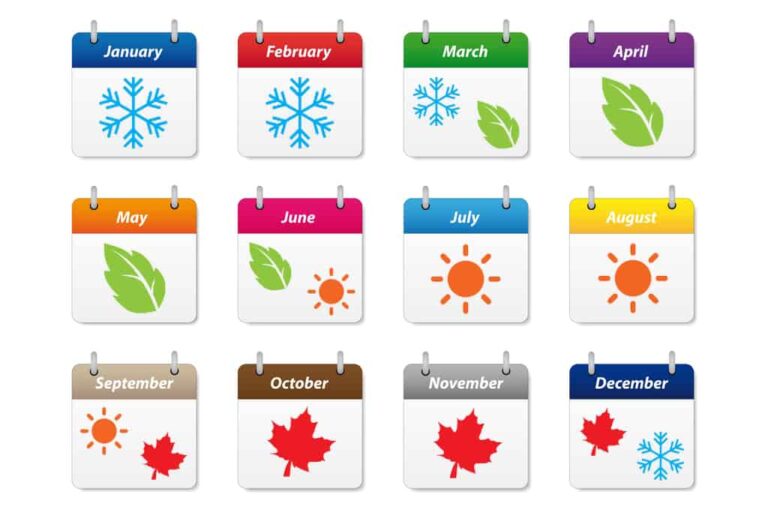
Switzerland has four seasons: winter, spring, summer and autumn. The summer months are warmest, winter months coolest.
Rain
Switzerland’s driest months and areas
Switzerland’s wettest months and areas
- Wettest months: May to August
- Wettest areas: all places high up in the mountains
General rain patterns
The amount of precipitation in Switzerland is highly variable. The Rhone Valley in the Valais is one of the driest parts of the country, sometimes locally comparable to a steppe climate. In this dry and sunny valley, grapes, apricots, and grapefruits grow. Most Swiss wine comes from this region too.
The Engadine Valley in the South-East is very dry as well, but it’s at a high altitude and therefore quite cold. The alpine regions get the largest amounts of rain and snow.
In general, there’s more precipitation in the western Alps, as clouds come in from the Atlantic and lose most of their water before reaching the south-eastern parts of Switzerland (Lake Maggiore, Lake Lugano, and the Engadine).
Variations in intensity and amount
The average precipitation varies per month and per Swiss region. These averages are normally reached by showers of medium intensity and days with steady, moderate rainfall.
However, global warming is causing more extremes: it can be bone dry for weeks or even months, either throughout the country or in specific regions. But ongoing and heavy rainfall can occur too, sometimes accompanied by hail, thunder, and strong wind. This can lead to floods, landslides, and damage to infrastructure.
Snow
Learn all about Swiss winter weather, and when and where to expect snow, here.
Swiss towns with the best weather
Towns with the most sun and the least rain
Few towns have the combination of many hours of sunshine and little rain. This is rare in Switzerland. Many more places have lots of sunshine combined with substantial rain.
The table lists towns with great weather on average and shows which months are the very best for lots of sun and the least rain. I’ve not taken temperatures into account.
| Town | Altitude | January | February | March | April | May | June | July | August | September | October | November | December |
|---|---|---|---|---|---|---|---|---|---|---|---|---|---|
| Brig | 691 m / 2,267 ft | x | x | x | x | x | x | ||||||
| Evolène | 1,377 m / 4,518 ft | x | x | x | x | x | x | ||||||
| Grimentz | 1,625 m / 5,331 ft | x | x | x | x | x | |||||||
| Martigny | 477 m / 1,565 ft | x | x | ||||||||||
| Müstair | 1,252 m / 4,108 ft | x | x | x | x | ||||||||
| Orsières | 901 m / 2,956 ft | x | x | x | |||||||||
| Pontresina | 1,829 m / 6,001 ft | x | x | x | x | ||||||||
| Saas-Almagell | 1,681 m / 5,515 ft | x | x | x | |||||||||
| Saas-Grund | 1,559 m / 5,115 ft | x | x | x | |||||||||
| Scuol | 1,246 m / 4,088 ft | x | |||||||||||
| Sion | 511 m / 1,677 ft | x | x | x | x | x | x | x | |||||
| St. Moritz | 1,775 m / 5,823 ft | x | x | x | |||||||||
| Verbier | 1,500 m / 4,921 ft | x | x | x | |||||||||
| Visp | 655 m / 2,149 ft | x | x | x | x | x | x | ||||||
| Zermatt | 1,605 m / 5,266 ft | x | x | x | x | x | x | x | x | ||||
| Zernez | 1,479 m / 4,852 ft | x | x | ||||||||||
| Zinal | 1,686 m / 5,531 ft | x | x | x | x | x | |||||||
| Zuoz | 1,705 m / 5,594 ft | x | x | x |
My conclusion for the best places to stay, by month:
- January: only towns in the mountains offer the very best weather. Examples are Evolène and Zermatt in the Valais, and St. Moritz in Graubünden.
- February: nearly all towns on the list are perfect.
- March: the Rhône Valley is nice (Brig, Visp, Sion). Evolène, Müstair, and Pontresina are good mountain resorts.
- April: Sion and Zermatt are perfect.
- May: this is a beautiful month in which I’ve had splendid weather in several Swiss areas. But there are no perfect average conditions anywhere.
- June: the Rhône Valley.
- July: still the Rhône Valley, but also the Saas Valley, plus Zermatt and its valley (the Matter Valley).
- August: the Rhône Valley.
- September: this is a beautiful month in nearly all listed towns. The air is often less moist than in previous months, which results in clear views.
- October: mountain towns in the Valais like Grimentz, Verbier, Zermatt, and Zinal are best.
- November: it’s not a great month, but overall, Evolène, Grimentz, and Zinal still have good chances of sunny skies.
- December: this is the perfect time for Orsières and Zermatt, as well as the higher towns in Graubünden like Pontresina, St. Moritz, and Zuoz.
A safe strategy: pick a central location
A base town with quick access to several Swiss holiday regions allows you to spread your weather chances and risks. You can travel in several directions and go where the weather is best.
Our region and town overviews help you pick the areas that match your preferences.
Best base towns for other types of weather
- If you prefer snow-covered towns or winter sports resorts, you should visit Switzerland in winter (January to mid-March) and pick towns above 1,500 m.
- For warm weather, you’d best stay in low regions in the south and visit during summer. Examples are Lake Geneva, the western Rhône Valley around Martigny, Sion and Brig, plus Lake Maggiore and Lake Lugano in the Ticino.
- If you want to avoid summer heat, Switzerland’s mountain resorts are your best bet.
Video 
The Föhn-wind
The so-called “Föhn” is a high-speed, cross-alpine wind, similar to the Chinook in the Rocky Mountains. It can occur all year long, but is most common in winter.
- If the wind blows from the south, it results in rain in the southern Alps, and dry warm fall winds in the northern Alps. If the Föhn occurs in winter or spring, it causes the snow to melt quicker.
- If the wind blows from the north (which happens less often), it results in rain in the northern Alps, and dry, relatively cool high-speed fall winds in the southern Alps.
How to prepare for Swiss weather
Check weather forecasts
Check the weather forecast on the evening before you plan to do a trip. Double-check the next morning, and check live webcam images of your destination too. The local forecast, specifically for the town or region you wish to visit, may provide more details as well.
Regardless of the predictions, the weather may change quickly and dramatic differences between one valley and the next are no exception. So it’s best to be prepared for weather variations.
Adjust to dangerous weather
Adjust your plans if weather dangers are expected for your region. For example: don’t go out hiking if there’s a risk of thunderstorms. Don’t go skiing or winter hiking in extreme cold or snow blizzards. Better be safe than sorry!
Pack the right clothes
Learn what to pack for all sorts of day trips and all-weather circumstances here.
A warming climate
Unfortunately, global warming causes significant changes to the temperatures, the climate and the geography of Switzerland. Learn all about it here.
Weather FAQ
-
What will the weather be like during my stay?
Long-term predictions for Swiss weather are impossible. You can get an impression of what to expect by looking at the general patterns for your town, region and time of the year.
Other than that, all you can do is keep an eye on the Swiss weather forecasts. They’re reliable about 5 days ahead.
-
What to do if weather is bad during my stay?
Continuous days of bad weather with ongoing heavy rain or thunderstorms don’t occur often. But if weather isn’t favorable during your stay, city visits and museums are perfect activities.
-
Is it worth visiting mountains in clouds or rain?
Visiting a Swiss mountain top is not worth it if continuous rain is expected, and if the mountain will be covered by clouds all day long. You won’t be able to enjoy the views.
However, when the weather alternates between sun and clouds, you can have brilliant moments at mountain tops. And if low clouds cover the valleys, skies may be clear at high altitudes. This especially happens in autumn and winter.
So always check the forecast and webcams showing live images for the mountain you want to visit.
-
Does Switzerland have snow all year?
No. Switzerland is not covered in snow all year long, not even in winter. The highest mountain tops usually have snow all year, but that’s still no guarantee.
Learn when and where to expect snow here.
More info about weather, clothing, and climate
Weather forecast
Winter weather and best time to visit
Best time to visit
Clothing and gear

Climate change in Switzerland
- www.meteoswiss.admin.ch: Swiss measurement values for temperature, wind, precipitation, sunshine and more
- www.meteoswiss.admin.ch: Swiss normal climate values
- www.meteoswiss.admin.ch: Swiss annual course series comparing current values against norm values
- www.meteoswiss.admin.ch: Swiss climate diagrams and norm values
- www.meteoswiss.admin.ch: climate change in Switzerland